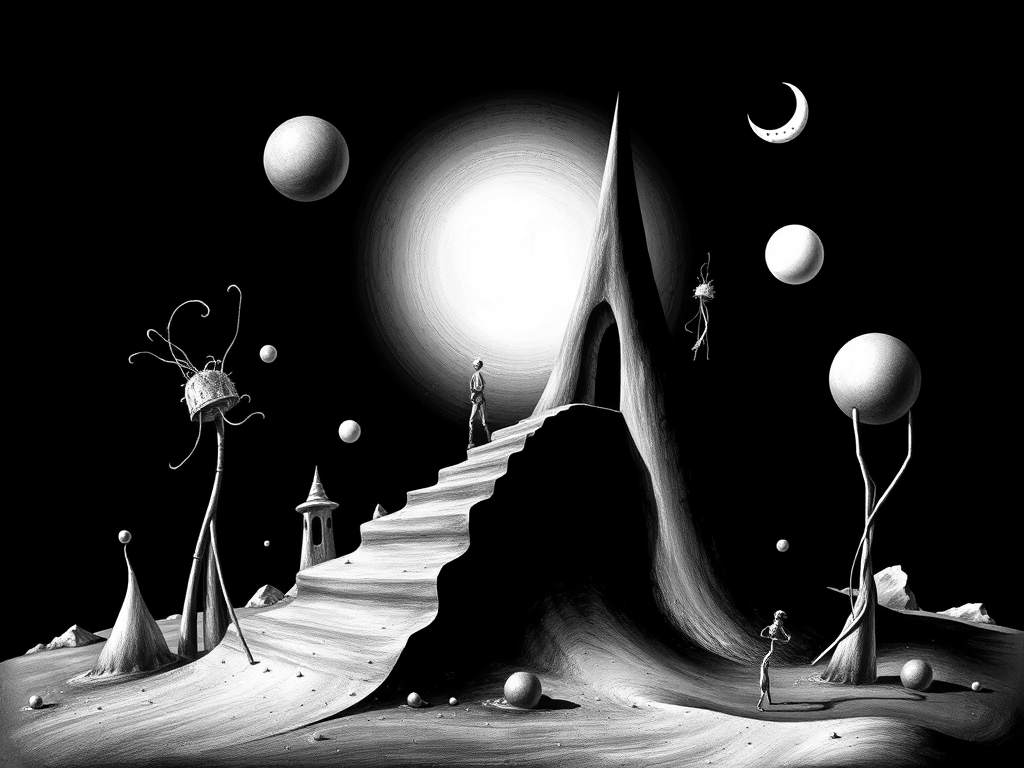
Certainty, if anything, self-illustrates the philosophical embodiment of a dualistic nature. Its very spirit of meaning is both contextually positive and negative. It is, on the one hand, an explicit and virtuous agent of change and on the other, one of stagnancy. For many, this is innately understood yet rarely consciously appreciated. It is often said that “the only certainty is change” or that “the only certainty is that nothing is certain.” Human nature pines for security and familiarity and change can often be reacted to as a threat to that very frame of mind. People may at some level recognize a need for change but loath or fear the sensation of movement and faith required to act on it. From such a point of view it can be said that the only thing hated more than change is staying the same. As useful as certainty is, when does it get in the way? When is it that we should cling to hope or alternatively give all to faith? When is it ideal to focus our energy on our own created expectations or when can we let things happen without interference from our beliefs?
Of course, I make no claim that certainty must simply be rejected. Like any tool it is best used in context for the job at hand. Certainty as a concept informs a personal and cultural frame of reference that is natural to our human nature. Certainty allows for confidence in prediction in relation to our earthly predicament. However, since the Renaissance, humanity’s so-called age or reason, certainty has often been elevated onto a coveted (sometimes sacrosanct) position in modernity. I would suggest that at times rightfully so but at other times very much to our detriment. In such circumstances certainty can act as a replacement to wonder or new acts of creation in favour of security, comfort, and familiarity. Ensuring reactive safety for its own sake, at the expense of understanding the intention of action or inaction, sidesteps a conscious evaluation of our truest circumstances and perhaps also a critical self-examination of our part within a greater whole. What is sometimes sold as certainty can turn out to be a neatly packaged exercise in deception. Sometimes this is intentional, and in other times simply through successful practice of human ignorance. Sometimes holding onto beliefs that are conditioned to prepare such safety and security for its own sake prevents the realization of where those very beliefs were intended to lead.
Likewise, this ‘reactive safety’ understood in part as survival instinct is also vital. It has an important role to play in protecting the earthly coil from an untimely demise. Whether it keeps us from being burnt, hit by a car, or eaten by a dinosaur, the certainty of our potential end in a world larger than ourselves is a clear and ever-present danger. For this, it serves us well. However, its very nature when left unobserved is like an ill-behaved dog off-leash. It is one that will, with certainty, dictate the terms and conditions of reality for the soul. When awareness becomes slave to the reactive, when the awareness lives vicariously through human instinct, it exists in a state of chaos from which all suffering finds its mark through anxiety, fear, and ignorance (to name a few). This is a space that lacks all possibilities for creative participation by merely reacting to all that has already been created. Effectively, you feed the wolf it gets bigger. Fear, anxiety, all the so-called reasons for suffering must come to us for life. They cannot be animated and find meaning without the soul. Consequently, the soul turns to these things for its death. The soul is not given into slavery, despite often being mixed in with that crowd. It was offered one of adoption through recognition of the knowledge between good and evil. Whatever you want to call it, whatever works for you, it comes down to which master do you serve?
The usefulness of certainty lies in the merits and results of the practice itself. I want to be a better painter, I must paint. I want to be a better Kung Fu-er, I must Kung Fu. Ultimately, If I want to be a better soul I must, therefore, practice reality. Or, at the very least, practice paying attention to it. Give life to your gifts and the world will open to you. The spice of life is the joy in realizing and not in always relying on the certainty of what others say. As the Buddha is claimed to have suggested: “question everything, even what I am saying.” The best practices are those that show that there is no need to dwell in suffering. The best practices are those that help us get out of our own way. They will foster and strengthen our innate abilities of realization, allowing us to see how our own conditioning animates fear and anxiety where none needs to exist. Indeed, the best practices allow for the recognition of conflict resolution before the need for conflict arises in the first place. In a world that always seems continually uncertain, where things are always changing and where various interests keep us in fear by design, the best practices are those that will allow the soul to be free of the vicarious servitude offered by the reactive. The only certainty needed is one that illustrates the nature of an entire reality of potential that completely and unconditionally supports you. What is created out of this certainty is entirely up to what you notice and put into motion.

 The Skypilot Missives
Leave a comment